Cats in Greece Are Everywhere — Here’s Why (And What Tourists Should Know)
Why are there so many cats in Greece? We noticed them everywhere! Here’s the story behind Greece’s stray cats, island cats, kittens and how tourists can help.
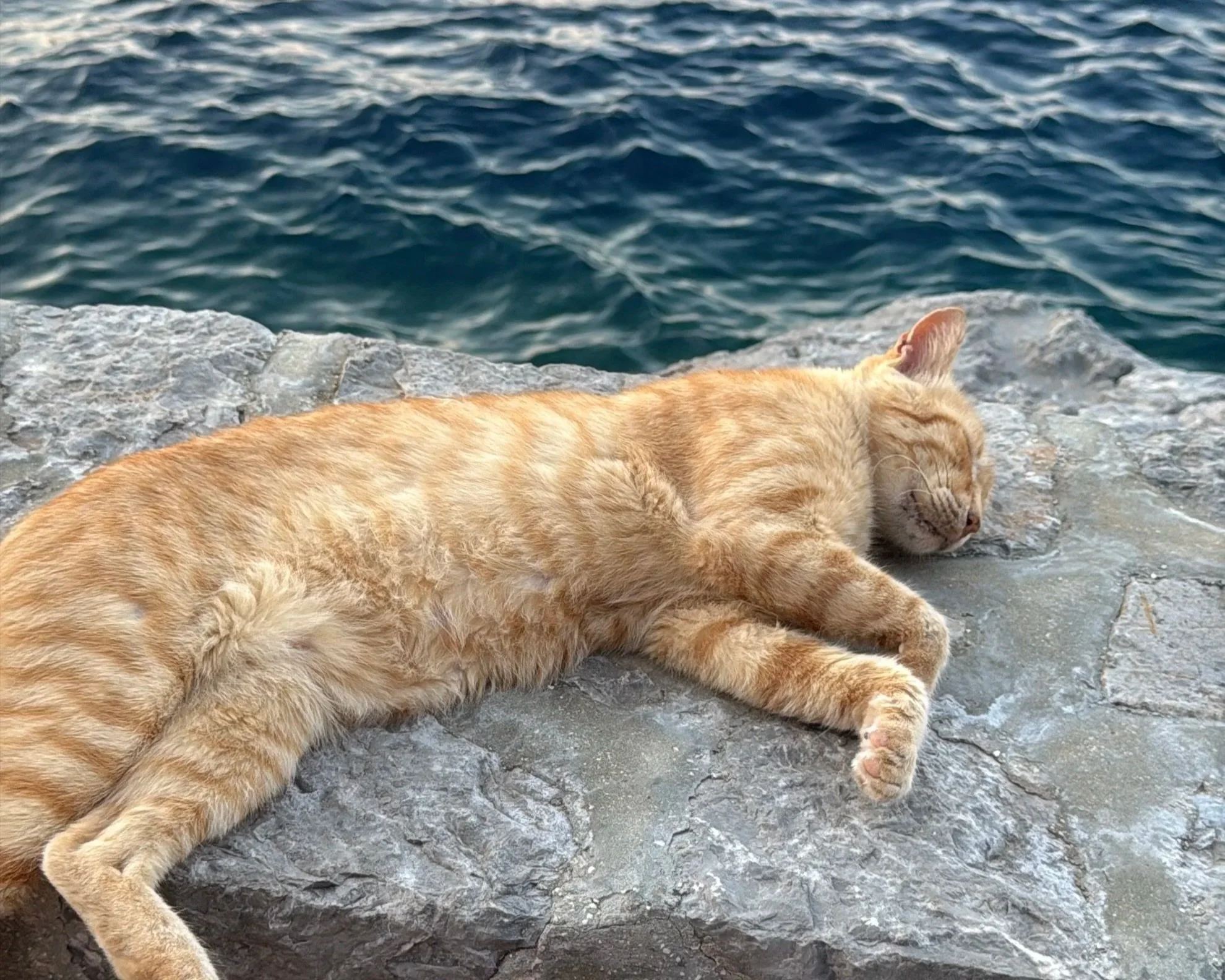
Photo: Internationista.com
One of the first things we noticed in Greece? The cats. Cats in Greece were everywhere. Curled up under café chairs. Lounging on sun-warmed stone walls. Wandering down little lanes as if they had somewhere terribly important to be. We saw big cats and tiny cats. Fluffy ones, skinny ones and every color imaginable. There were even teeny kittens roaming around, and no one batted an eye. Meanwhile, we were the tourists stopping every few minutes because, “Wait. LOOK AT THIS ONE.”
It didn't take long before spotting cats in Greece became part of the trip. We'd sit down to eat and—oh, hello—there'd be a furry little face peeking out from under the next table. On the islands especially, cats seemed as much a part of the scenery as blue shutters and whitewashed houses. But after seeing so many, we started wondering about them. Are all these cats actually homeless? Who feeds them? Why are there so many? And is that tiny kitten currently staring at my lunch someone's pet, or have I just been expertly manipulated by a four-pound criminal?
Read on, because the story behind Greece's famous cats is a lot more complicated than we expected.
Cats in Greece: The Quick Answer
If you've landed here wondering why are there so many cats in Greece, there isn't one single reason. Greece has an enormous free-roaming cat population, and many of those animals aren't sterilized. That means new litters can be born surprisingly quickly. The country's climate also allows cats to live outdoors throughout much of the year, while food and water supplied by local residents help support established cat colonies.
And we're not talking about a handful of cats hanging around a few touristy islands.
According to Animal Action Greece, Greece is home to an estimated 3 million stray cats. The organization says a fertile cat can have an average of three litters per year, with an average litter containing four to six kittens.
Yep. Suddenly all those kittens make a little more sense.
Why are there so many stray cats in Greece?
The biggest piece of the puzzle is reproduction. Animal Action Greece estimates that there are around 3 million stray cats in Greece. According to the organization, kittens can reach sexual maturity at around four months old. A fertile female can produce an average of three litters in a year, with around four to six kittens in each litter.
You don't need to be particularly good at math to see where this is going.
Animal Action Greece says that one unspayed female and her descendants could theoretically produce thousands of kittens over seven years. That's why neutering programs are such a big deal. Feeding existing cats helps them today; preventing endless new litters tackles the problem at its source.
There is an interesting wrinkle in the numbers, though.
At the end of August 2025, Greece's National Register of Companion Animals contained 158,319 registered stray cats, and 68% of them were recorded as sterilized. That obviously sounds very different from an estimated population of 3 million.
It doesn't mean one figure is necessarily “right” and the other is “wrong.” The government figure counts cats recorded in the national system. It's not a census of every cat wandering around Greece. In fact, the government's own municipal monitoring data showed gaps in registration.
So the true number is difficult to pin down. What isn't difficult to see, as anyone who has spent much time wandering around Greece can tell you, is that the free-roaming population is substantial.
Are the cats in Greece actually stray?
This was one of the things we wondered about most because some of the cats we saw looked remarkably comfortable with their setup.
The answer is: some are genuinely stray, but “stray” doesn't quite describe all of them.
A better term for many is community cat or free-roaming cat. These cats don't necessarily have one owner waiting for them at home. Instead, they live outside and may be fed by restaurant workers, residents or volunteers. Some have people regularly monitoring them and getting them veterinary treatment.
Others really are feral cats in Greece with limited human contact. There are also abandoned pets and kittens born outside to unsterilized mothers.
And then you've got those ridiculously friendly characters who stroll up as if they've been expecting you all morning.
Under Greece's animal-welfare system, municipalities have responsibilities for managing stray companion animals. The country's national system includes programs for registering, sterilizing and putting stray animals up for adoption.
So the sleepy cat you see sprawled across a village step may not have a conventional owner, but that doesn't automatically mean nobody is looking after it.
Very cat-like, really. Why settle for one human servant when you can have an entire neighborhood?
Why are there so many cats on the Greek islands?
If you've spent time island hopping, you've probably noticed that the cats can feel especially visible there.
There isn't one mysterious cat island in Greece where they've staged a feline takeover—although, at times, it genuinely feels like it.
Island communities can have established colonies of free-roaming cats concentrated around villages and other reliable sources of food. Restaurants and harbors can become particularly attractive places to hang around. Once a population becomes established, a lack of sterilization allows it to grow quickly.
Animal Action Greece's work on Paros and Antiparos gives a fascinating look at how organizations are trying to change that.
Its community cat program uses a Catch-Neuter-Vaccinate-Return approach, often shortened to CNVR. Cats are caught and sterilized, given veterinary care and then returned to their communities. Animal Action Greece says its goal is to sterilize at least 80% of cats in the project area to help stabilize the population.
The organization reports that more than 5,000 cats have been neutered through its Paros and Antiparos project since April 2023.
That's a lot of cats—and a lot of future kittens prevented.
Do people in Greece take care of the street cats?
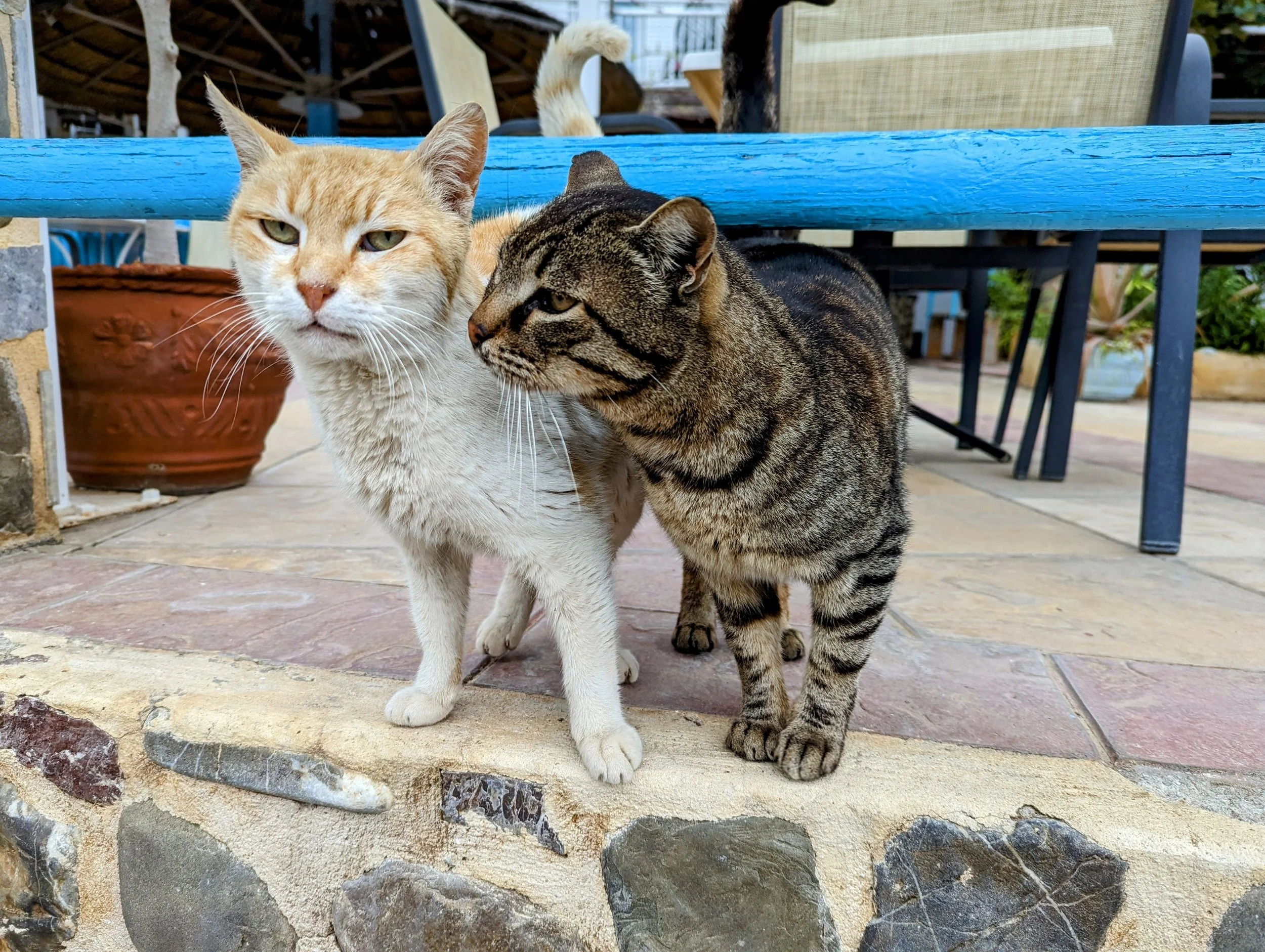
Photo: Pexels/Andre
Yes. And this was something we started noticing once we knew what to look for. You might see bowls of water tucked beside a wall or food left in a quiet spot. Some local residents regularly feed neighborhood cats, while volunteers and animal-welfare groups organize neutering and veterinary treatment.
Greek authorities have also made clear that caring for and feeding stray animals is allowed when it's done in accordance with animal-welfare and hygiene requirements.
But—and this is important—the fact that you see people feeding cats in Greece doesn't mean every cat has somebody taking care of it.
Animal Action Greece says some homeless cats can go their entire lives without veterinary treatment or shelter. Injuries and disease are real concerns, particularly for cats living completely outdoors.
That's one reason the situation can feel a little contradictory as a visitor. You can see a perfectly plump cat snoozing happily beside a taverna, then turn a corner and spot another that clearly isn't doing nearly as well.
They're both part of the same much bigger story.
Is it okay for tourists to feed cats in Greece?
This is where we'd use a little common sense rather than immediately handing over half the dinner table.
Greek authorities have defended the right to feed and care for stray animals when it's done responsibly and hygienically. But official travel-health advice is more cautious about interacting with unfamiliar animals.
If you do choose to help a known community cat or you're following guidance from a local rescue, proper cat food and clean water are much better choices than leftovers from your dinner.
Animal Action Greece specifically warns against well-intentioned foods such as fish bones and raw meat. Bread and pasta aren't appropriate substitutes for a balanced cat diet either.
And milk? Despite what cartoons have been telling us our entire lives, don't reach for the saucer.
Also pay attention to what's already happening around you. If a hotel, restaurant or rescue group is managing a colony, ask before creating your own impromptu buffet. Regular feeding programs are far more useful than a mountain of food appearing one afternoon and disappearing when the tourists leave.
Those eyes will still try to convince you otherwise. Stay strong.
Can you pet stray cats in Greece?
Here's where being a cat person and being a sensible traveler have to meet somewhere in the middle. Some Greek street cats are extremely friendly. We certainly encountered cats that seemed perfectly happy around people. Others will make it abundantly clear that your friendship has not been requested.
From a travel-health perspective, though, the safest advice is not to pet unfamiliar stray animals. Bites and scratches can become infected, and international travel-health guidance recommends avoiding unnecessary contact with unknown animals.
If you do interact with a familiar community cat, never chase or corner it. Leave nervous cats alone and be especially cautious around an animal that appears sick or injured.
And if you're bitten or scratched, don't shrug it off because the culprit was adorable. Wash the area thoroughly and seek appropriate medical advice. Cute does not equal vaccinated.
What does a clipped ear on a cat in Greece mean?
We love this one because once you know what you're looking for, you'll start spotting it. If the very tip of a cat's ear has been neatly removed, there's a good chance the cat has been through a sterilization program.
It's known as ear tipping. Animal Action Greece explains that a small portion of the ear is surgically removed while the cat is under anesthesia for its spay or neuter operation. It gives volunteers an easy way to tell from a distance that a free-roaming cat has already been sterilized.
That's important because otherwise somebody would have to catch the same cat again just to find out.
So if you notice an ear-tipped cat lounging around like it owns the island, that tiny missing tip can actually be a very positive sign: somebody has already intervened to stop it contributing to another generation of homeless kittens.
Why do Greek restaurants have so many cats nearby?
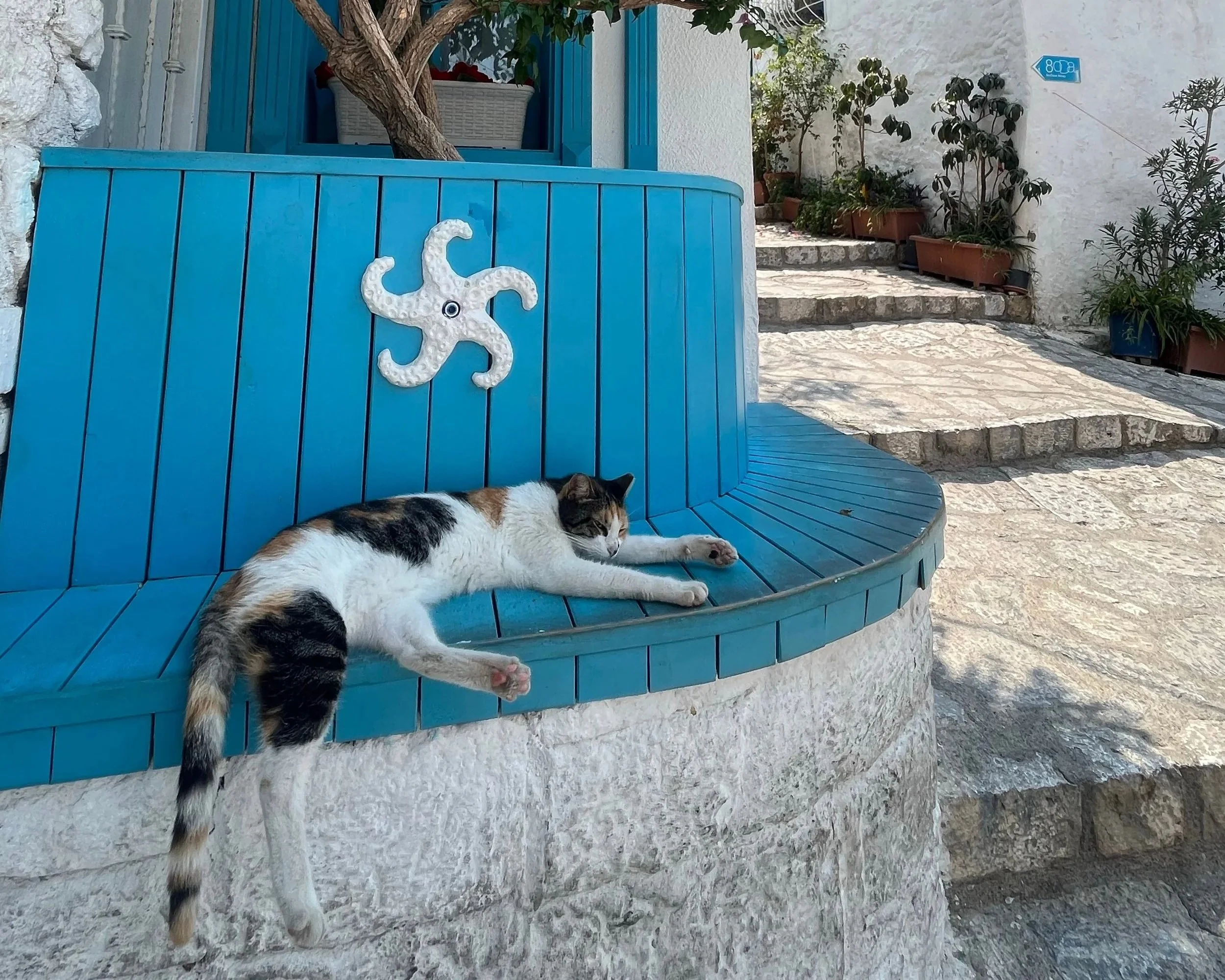
Photo: Pexels/ Ayşenur Cufdar
Because, frankly, if you were a cat, wouldn't you hang around a Greek restaurant too? Outdoor tavernas offer shade and people. More importantly, they offer food.
Cats are very good at learning where reliable meals come from. If restaurant staff or nearby residents feed a local colony, cats have an obvious reason to return. Add diners who can't resist those enormous hopeful eyes and you have yourself a pretty successful feline business model.
We noticed this again and again. We'd sit down for a meal with no cat in sight, then somewhere between the drinks arriving and the food hitting the table... Cat.
Sometimes more than one. This is why cats in Greece can suddenly seem particularly abundant around tavernas and cafés. It isn't that every restaurant has somehow been assigned six cats by the Greek tourism board. The animals simply know where the action is.
And they are very, very good at looking hungry. Oscar-worthy performances, really.
Do cats in Greece have rabies?
This is an understandable question, especially if you're surrounded by free-roaming animals.
The U.S. Centers for Disease Control and Prevention says that dogs infected with rabies are not commonly found in Greece and that rabies vaccines are generally available throughout most of the country if an exposure occurs.
That doesn't mean travelers should assume every unknown animal is risk-free.
The CDC advises travelers not to touch unfamiliar animals and recommends seeking medical attention after an animal bite or scratch. Rabies is extremely serious, so an exposure isn't something to self-diagnose based on how healthy or friendly an animal looked.
In other words: don't panic because a cat walked past your table. Just use normal precautions around animals you don't know.
What were cats in ancient Greece like?
Here's the plot twist we weren't expecting. With so many cats around modern Greece, you could easily assume the country has been cat-obsessed since antiquity.
Apparently not. The history of cats in ancient Greece is much murkier. A scholarly article published by Cambridge University Press notes that the domestic cat does not appear to have been commonly known in Greece proper and remained much more closely associated with Egypt until later periods. And who was dealing with the mice? Weasels were among the animals used for pest control.
There is also archaeological and genetic evidence that cats spread through Europe alongside human movement and trade. Research published in Heredity notes the role of Greek and Phoenician traders in the later movement of domesticated cats through Europe.
So the cats draped across seemingly every wall today aren't simply carrying on some uninterrupted ancient Greek tradition. Sorry, cats. You don't get to take credit for everything.
Can you adopt a stray cat from Greece?
Yes, and Greece actually has an official system for it. The Greek government operates the Panhellenic Platform for the Adoption of Stray Companion Animals, which sits within the National Register of Companion Animals. Registered animals available for adoption can be listed there by municipalities and authorized animal-welfare organizations.
If you fall hopelessly in love with one particular cat while traveling—and, honestly, we can see how this happens—don't simply scoop it up and head for the airport. First establish whether the cat actually needs a home. Remember, a free-roaming cat may already be part of a managed colony or even belong to somebody.
If adoption is appropriate, work with an established rescue or local authority. Taking a cat internationally also means meeting the destination country's requirements for identification, vaccinations and travel documents. This is definitely one of those situations where love at first sight requires paperwork.
What should you do if you find an injured cat in Greece?
If a cat looks seriously ill or injured, the most useful first move is to contact a local animal-welfare organization or veterinarian. A frightened animal in pain can bite or scratch even if it normally loves people, so don't assume you need to pick it up yourself.
Take note of exactly where you saw it. A photo can also be useful when contacting a rescue because it helps them identify the animal and assess the situation. On islands with organized community-cat projects, there may already be volunteers who know the local colonies—and possibly the individual cat. That's far more useful than trying to become an emergency veterinarian halfway through your vacation.
How can travelers responsibly help cats in Greece?
After seeing so many of them, it's natural to want to do something. The most useful help, though, isn't necessarily feeding every cat that wanders past your hotel.
Support sterilization programs. This is one of the biggest ways to address the problem long-term. Fewer unplanned litters mean fewer kittens born into an already enormous free-roaming population.
Donate to established local animal-welfare organizations. That money can go toward neutering and veterinary treatment as well as food.
Leave clean water where appropriate. Greece gets seriously hot, and access to fresh water matters.
Follow existing feeding programs. If locals or volunteers are already caring for a colony, ask what would actually help.
Report sick or injured animals. Local rescues and veterinarians are better equipped to help than most travelers.
Don't separate kittens from their mothers unnecessarily. A kitten being alone for a while doesn't automatically mean it has been abandoned.
And perhaps most importantly, remember that cats in Greece aren't just a cute travel photo opportunity. We loved seeing them. It was impossible not to. The fluffy ones sprawled across steps, the tiny kittens and the shameless restaurant beggars became one of those little details we now associate with being in Greece.
But once you know there are an estimated 3 million stray cats in the country, you start looking at them a little differently. Yes, take the photos. Say hello to the restaurant regulars from a respectful distance. Laugh when yet another cat magically appears the second your dinner arrives.
Just remember there's a genuine animal-welfare issue hiding behind all that cuteness. And whatever you do, don't let the tabby under your table convince you he hasn't eaten in six months. He's been working Table 7 all evening.